
If you are new to writing, you may be tempted to approach it as though it were an exercise in acquiring another person's mannerisms. You may discover a writer whose work you admire, study the writer's expressions, notice how their sentences are constructed and begin to incorporate similar flourishes into your own work. Before long, you may find that you are no longer writing in your natural voice; you are attempting to reproduce someone else's.

It is perfectly reasonable to admire another writer. Indeed, every serious writer ought to read widely, study good literature and learn from those who have mastered the craft. But there is a distinction between learning from a writer and attempting to become that writer. The former develops your judgement; the latter may prevent you from developing your own voice.
I always make it a point to tell people that I do not know a good writer who is not a good reader. I have worked with a few writers whose work would make me cringe. It is pure regurgitation: no life, no originality, no evidence of an independent mind at work. In fact, the problem has become even more pronounced in the age of AI.
Let me be clear: I am not saying that people should not use AI. I use it myself, and I think it is foolish to ignore a tool that can make our work faster and more efficient. Large language models are useful tools, and there is much we can accomplish with them. However, as some researchers have warned in their studies of AI use, we must not allow these tools to do our thinking for us. AI can assist with the process of developing an idea, examining an argument, refining a sentence and exploring possibilities. But it should not replace the writer's own judgement, understanding or intellectual effort.
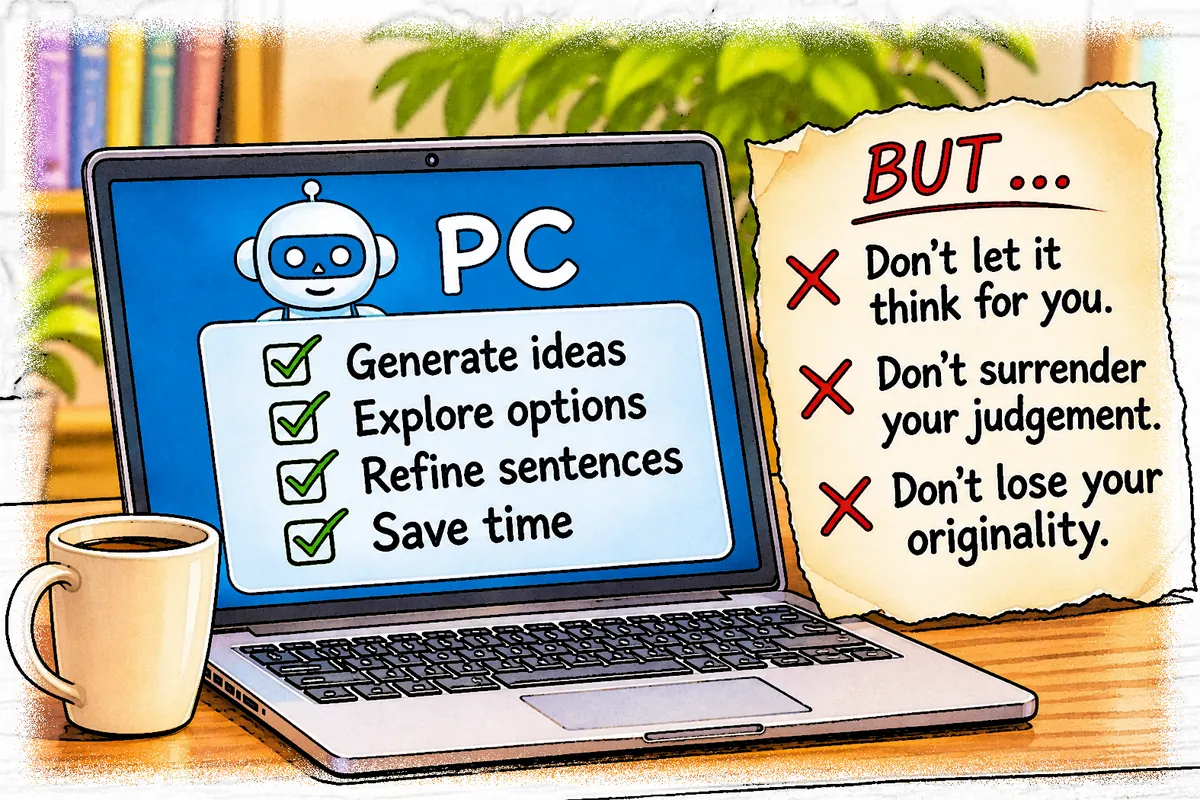
I have said this repeatedly: AI is not a writer. It is a tool, and the quality of what it produces depends greatly on what goes into the process and how thoughtfully its output is used. It can generate words, arrange arguments and produce remarkably convincing prose, but that does not mean the person using it has necessarily thought through the subject. There is a danger in becoming so dependent on AI that we surrender the very faculties that make us writers: observation, judgement, curiosity, imagination and the ability to form an original thought.
The same principle applies to writing itself. It is irresponsible to spend your writing life reproducing the expressions, habits and mannerisms of other writers without making the effort to develop a style of your own. Learning from others is part of the craft; becoming a copy of them is not.
I like C.S. Lewis. In fact, I am particularly interested in studying his work in depth. What a genius he was! I think what made his writing remarkable was not merely his vocabulary or command of grammar, but also his ability to communicate difficult ideas with extraordinary clarity, imagination and intellectual force. He could write about theology, morality, human nature and the Christian faith without making every discussion sound like an academic lecture. He understood the value of an illustration, the force of a well-constructed argument and the usefulness of ordinary language in explaining extraordinary ideas.
In Mere Christianity, for instance, Lewis takes complex questions about Christian belief and approaches them in a manner that invites the reader to think alongside him. In his fiction, particularly The Chronicles of Narnia, he communicates moral and spiritual truths through story, character, conflict and imagination. His work demonstrates that profound thought need not be buried beneath complicated language, and that intellectual depth does not require an unnecessarily difficult style. Oh, God bless C.S. Lewis! What a mind he had! But I digress.
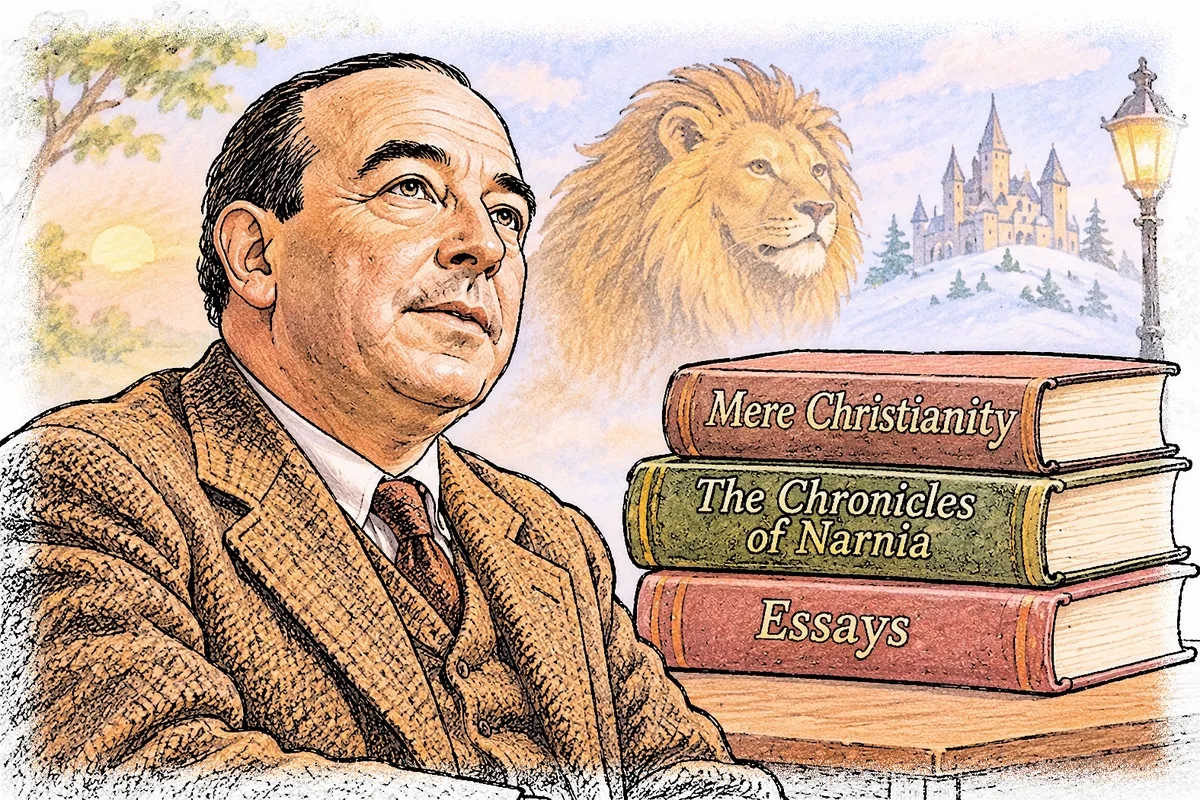
My point is that Lewis did not become Lewis by attempting to sound like another writer. His writing emerged from his particular intellectual interests, his extensive reading, his convictions, his experiences and his imagination. These things gave his work its distinctive character.
That is an important distinction for anyone who wishes to write well. Your voice is not simply the words you prefer to use. It is the expression of how you think, what you notice, what you believe, what interests you and how you interpret the world around you. It is revealed in the arguments you make, the illustrations you choose, the questions you ask and the manner in which you lead a reader through an idea. If you want to be a writer, then write!
You can, and should, have great writers whom you look up to. I think you must. After all, how can you have an ideal to aspire to if you have no examples of people whose standards you respect and whose work challenges you to improve?
But it is futile simply to reproduce other people's writing and present it as your own. You deprive the world of your uniqueness when you do that. In fact, I make bold to say that you do a disservice to the very individuality that makes your contribution worth reading.

Right! Let us address one of the misconceptions about developing a writing voice: the belief that it requires acquiring a distinctive vocabulary.
I mean, read widely and grow your vocabulary. I intend to spend some time studying my dictionary after writing this piece. I used to do that, and now that we are discussing vocabulary development, I think I will make a deliberate effort to return to the habit. It is a wonderful way to discover new words and become more familiar with the possibilities of language.
But some writers believe they must find unusual words, employ elaborate expressions or construct unusually long sentences to establish an identity on the page. Others adopt an archaic register because they associate it with intelligence and literary distinction. Although I happen to like older and less commonly used words, that is my peculiarity. It is my taste; it is my idiosyncrasy. It is not what makes me a good writer, nor is it proof that I am one.
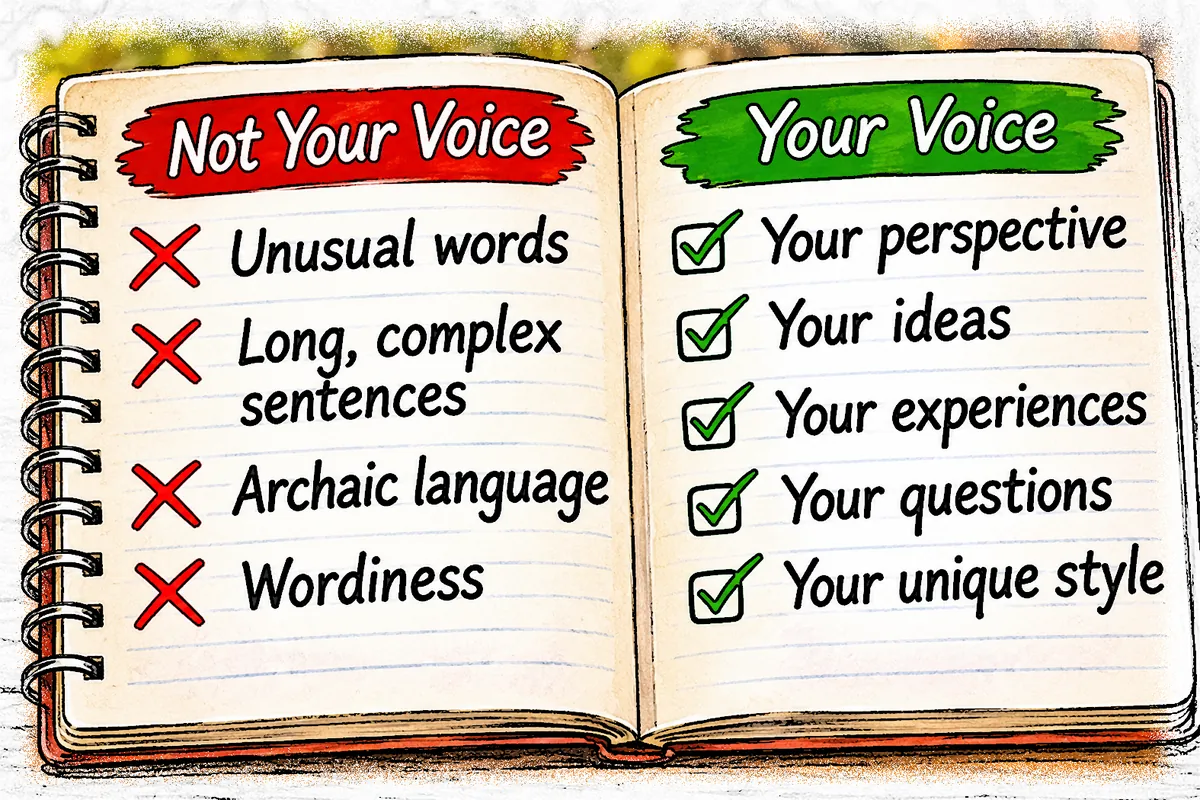
A writer's voice cannot be manufactured through vocabulary alone. A person may possess an extensive vocabulary and still have nothing distinctive to say. Another may use predominantly familiar words and yet produce writing that is unmistakably their own.
Think about the difference between two writers discussing the same subject. One may approach it through a carefully reasoned argument; another may draw on personal experience, while a third may use humour and illustration. Their vocabulary may overlap considerably, but their treatment of the subject will differ because their minds approach it differently.
Your voice is therefore not something you acquire by collecting impressive expressions. It develops as you learn to express your thoughts with increasing clarity, confidence and individuality.

This does not mean that you should never expand your vocabulary or experiment with different forms of expression. You should. A writer must be willing to learn new words, explore different registers and become acquainted with the possibilities of language. But these should become instruments in your possession, not disguises behind which you hide.
Many people write differently from the way they ordinarily communicate because they believe writing must sound formal to be taken seriously. They abandon familiar expressions, introduce unnecessarily complicated constructions and adopt a tone they would never use in ordinary conversation. The result is often stiff, artificial prose.
Of course, there are occasions when formal writing is necessary. The nature of the subject, the intended audience and the purpose of the communication may require a particular level of formality. A legal document, an academic paper, an official letter, a theological treatise and a corporate report, for instance, may demand a more formal register. This is not a rule that applies to every form of writing, however. A columnist, copywriter, journalist, novelist, memoirist, children's author, blogger, speechwriter, playwright or content creator must understand that different forms of writing call for different approaches. Even within these professions, the appropriate tone depends on the publication, audience and purpose.
This does not mean that writing should reproduce casual speech in its entirety. Spoken language has repetitions, unfinished thoughts, grammatical shortcuts and expressions that may not belong in a finished manuscript. Writing requires selection, arrangement and refinement. But refinement should not erase the writer's natural character.
The aim is not to write exactly as you speak; it is to retain the naturalness, warmth and directness of your own expression while giving it the discipline that good writing requires.
A formal letter, a theological article, a memoir, a children's story and a business report do not demand the same register. The writer must understand the occasion and adjust accordingly. Yet even when the register changes, something of the writer's intellectual character should remain recognisable.
This is where style becomes a matter of judgement. You must know when the occasion calls for restraint, when it permits humour, when a technical expression is necessary and when an ordinary word will communicate the thought more effectively. Good writing is not about sounding formal at every opportunity; it is about knowing what the occasion requires and having the command of language to meet it.
A writer's voice is also shaped by the willingness to take responsibility for what is being said. Some writers weaken their arguments through excessive qualification. They repeatedly introduce phrases such as "perhaps", "it may be argued", "in some sense" and "it could be suggested", even when they have a clear position to defend.
There is, of course, a place for qualification. Intellectual honesty requires us to distinguish between what we know, what we believe, what we suspect and what remains uncertain. A writer should never present an assumption as an established fact or express certainty where the evidence does not warrant it.
But there is a difference between intellectual humility and habitual hesitation. If you have a considered position, express it. If you are uncertain, acknowledge the uncertainty precisely. Do not allow unnecessary qualifications to drain the conviction from every sentence.
C.S. Lewis's writing is instructive in this regard. He was willing to examine objections, acknowledge difficult questions and engage opposing arguments. His confidence did not depend on pretending that every question was easy. Rather, he took the reader through his reasoning and allowed the argument to carry its own weight.
A writer should aspire to that kind of intellectual honesty. Do not write merely to sound convincing. Develop your thought sufficiently to have something worth defending.
It is difficult to develop a mature writing style without reading. Reading exposes you to different ways of constructing arguments, developing characters, explaining ideas and employing language. It enlarges your vocabulary, sharpens your judgement and introduces you to possibilities you may not have considered.
Read writers whose styles differ from your own. Read classical literature, biographies, essays, history, theology, fiction and good contemporary writing. Pay attention to how an author introduces an argument, develops a paragraph, uses an illustration or brings a discussion to a close.
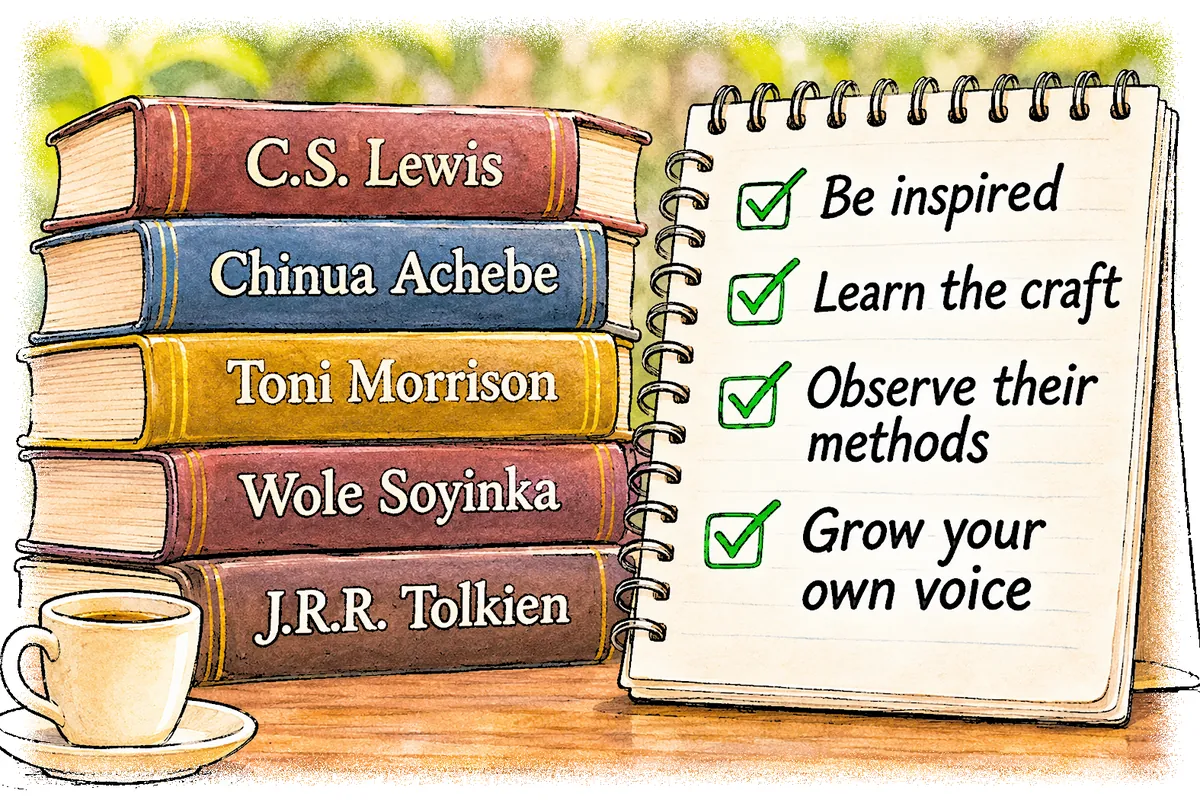
When you admire a passage, do not merely admire the words. Examine the thinking behind them. Why does the illustration work? How has the writer arranged the argument? What makes the sentence memorable? Is it the vocabulary, the rhythm, the contrast, the precision or the idea itself?
Learn from the craftsmanship without borrowing the identity.
There is nothing wrong with being influenced by the writers you read. Every writer is shaped, to some extent, by the books, ideas and voices encountered over the years. The problem arises when influence becomes imitation and admiration becomes dependence.
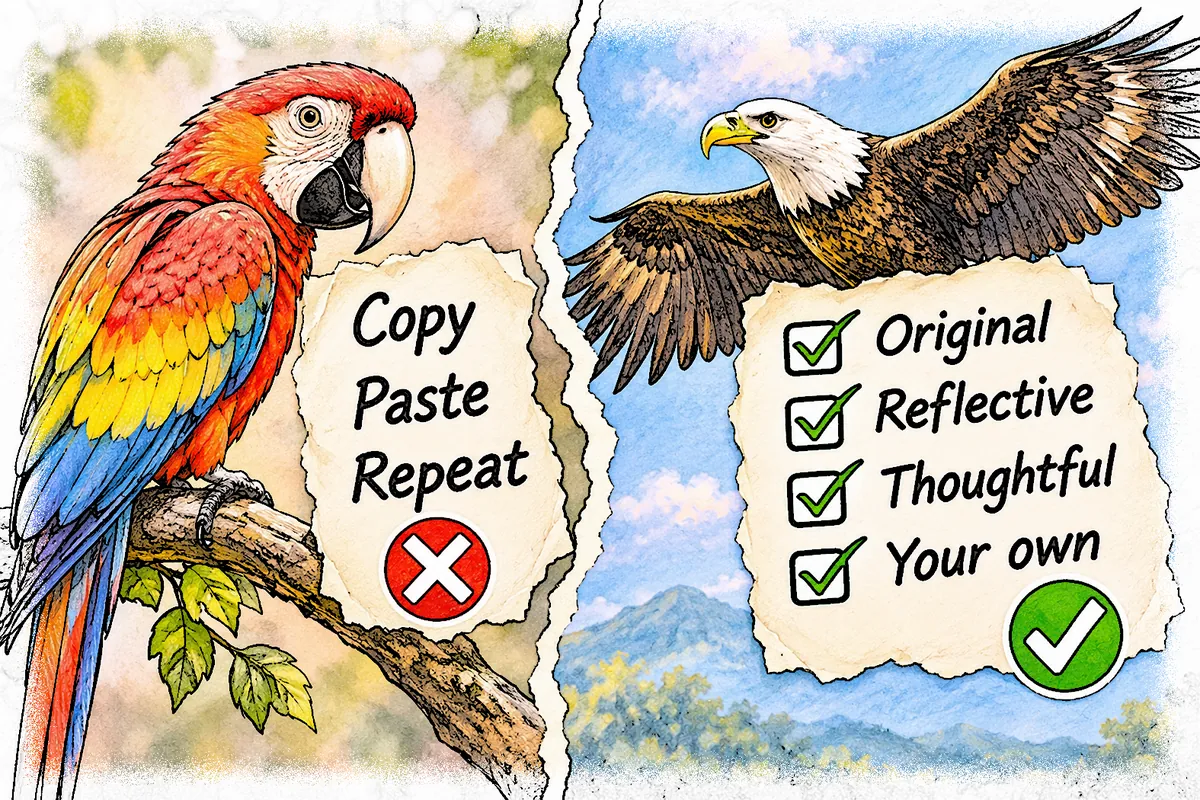
Your task is not to sound like C.S. Lewis, Shakespeare, Jane Austen or any other writer you admire. It is to learn from their command of the craft while developing the capacity to express your own thoughts with equal care and sincerity.
Developing a writing voice requires time. It is not a technique that can be mastered through a few exercises or acquired by memorising a set of writing rules. It develops through reading, writing, revising, thinking and paying attention to the way you express yourself.
Write frequently. Give yourself room to explore ideas, develop arguments and experiment with different forms of expression. Then return to your work and examine it. Identify the expressions that sound natural and those that feel forced. Notice the kinds of illustrations you instinctively use, the subjects that interest you and the manner in which you tend to approach a question.

Read your work aloud. If a sentence sounds as though it belongs to someone else, examine why. Perhaps you have adopted an expression you would never ordinarily use. Perhaps the construction is unnecessarily elaborate. Or perhaps the sentence is perfectly appropriate for the subject but requires a little more refinement.
Do not mistake every unfamiliar expression for artificiality. Sometimes, writing will require you to stretch beyond your ordinary vocabulary. The important thing is that the expression should be deliberate and appropriate, not an attempt to impress.
Above all, do not be afraid of your own voice. Your experiences, convictions, observations, intellectual interests and manner of reasoning are part of what you bring to the page. You do not need to manufacture a personality for your writing. You need to develop the discipline to express the one you already possess with clarity and distinction.

Choose a subject you know well and explain it as though you were speaking to someone genuinely interested in understanding it. Do not begin by trying to sound impressive. Simply explain what you think, why you think it and what you want the other person to understand.
Now write the same explanation as a short article.
Compare the two versions. Have you introduced expressions you would never ordinarily use? Have you made the argument unnecessarily complicated? Have you lost the natural progression of your thoughts in an attempt to sound formal?
Revise the article without making it casual or careless. Retain the clarity of your spoken explanation, but give the writing the structure, precision and discipline it requires.
Then read something written by an author you greatly admire. Examine the craftsmanship, not merely the style. Identify one technique you can learn from without copying the author's mannerisms.
The objective is not to become another writer. It is to become a better version of the writer you are.
Good writing should bear the marks of thought, discipline, experience and individuality. Let your work demonstrate that you have something of your own to say, and that you have taken the care to say it well.
Inspired by William Zinsser’s On Writing Well.
Layo Obidike
LO Publications

What New Authors in Canada Get Wrong About Book Marketing: A breakdown of Canadian publishing realities
September 4, 2026

7 Common Writing Mistakes
January 21, 2026

Book Marketing 101
January 21, 2026
Get the latest publishing, book marketing & writing craft insights.